
Copyright © 2026 Innrox, Inc., an Innrox Group company. All rights reserved.

InnRox
Travel Experts
June 18, 2026
18 min read
The first thing a traveler sees in 2026 is rarely a lobby. It is a grid of rooms, rates, stars, review snippets, cancellation notes, taxes, add-ons, and tiny promises that all compete for attention before the suitcase is even zipped.
A business traveler landing late in Chicago may see one hotel near O'Hare for less than a downtown room and assume the airport stay is the sensible choice. A couple planning Paris may see a "city view" upgrade and imagine rooftops, only to discover the view is mostly an inner courtyard and a sliver of skyline. A family going to Tokyo may choose a cheaper hotel two train transfers away from their main activities, then spend the savings on transit, taxis, and tired children.
That is why a good hotel booking service in 2026 should do more than display available rooms. It should help travelers understand the real shape of a stay: the neighborhood, the total cost, the tradeoffs, the cancellation risk, and the value of time. The best booking experience now feels less like a catalog and more like a smart conversation with someone who has walked the route from the station, checked the breakfast price, and noticed when a "deal" quietly becomes expensive.
Hotel pricing has become more transparent in some ways and more complex in others. Travelers know to compare room rates, but the true cost of a stay often lives in the margins: parking, breakfast, resort or destination fees, local taxes, early check-in, late checkout, airport transfers, spa access, beach chairs, minibar handling, and mandatory service charges.
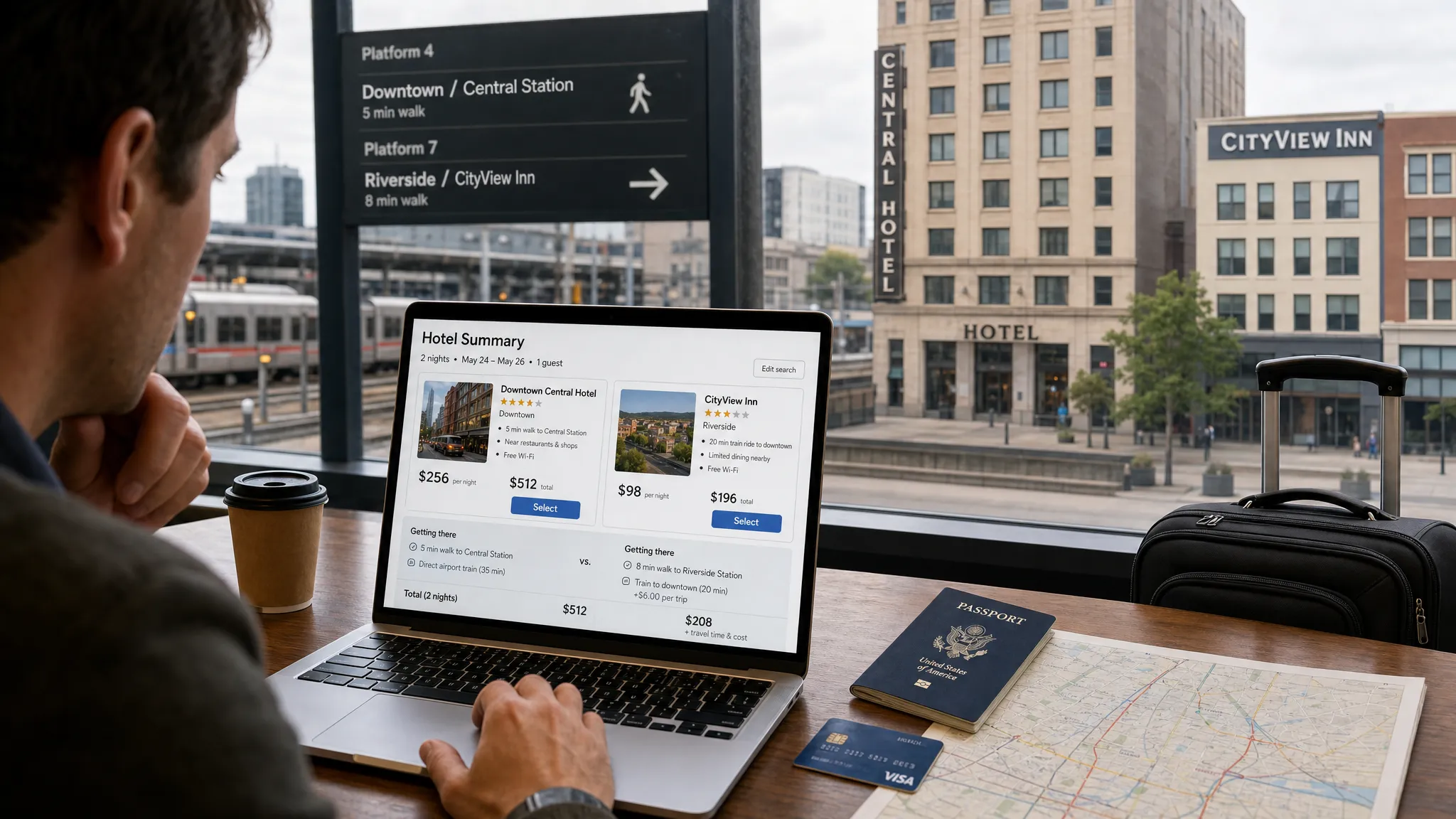
A good booking service should put that reality in front of the traveler before payment. Not as a frightening footnote, but as a clear total. If a room is $40 cheaper per night but sits far from the conference venue, charges for breakfast, and requires a taxi after evening meetings, it may not be cheaper at all.
Take Chicago. A riverfront hotel can seem expensive compared with a suburban or airport option, but the math changes if your meetings are in the Loop or River North. Staying central may mean walking to dinner, avoiding rides at peak times, and getting back to your room between appointments. For a polished central benchmark, a traveler might compare availability around The Langham Chicago against less expensive outer-area properties, then calculate the cost of transit, time, and convenience rather than judging by room rate alone.
The same logic applies to leisure stays. If you are in a city for two nights, every 25-minute commute is expensive, even when it is not charged to your card. The value question is not, "Which hotel is cheapest?" It is, "Which hotel lets this trip work without constant friction?"
That is where many travelers lose money without realizing it. They book the lowest visible rate and only later notice the total cost: a breakfast buffet that costs more than a neighborhood cafe, parking that adds the price of another room night over a long weekend, or a nonrefundable rate that becomes painful when a flight schedule changes. For a deeper look at these quiet cost leaks, Innrox has covered common hotel booking mistakes that quietly raise your total cost, and the lesson is simple: the room rate is only the opening line.
A hotel booking service should make that opening line honest.
A hotel is not only a building. It is a temporary address, and that address shapes the rhythm of the trip.
In Paris, the difference between staying near the Louvre, in Saint-Germain, around the 9th arrondissement, or farther east toward the 11th is not just aesthetic. It affects dinner spontaneity, museum access, nightlife, late-night taxi needs, and how much of the city feels like a postcard versus a lived-in neighborhood. A grand central hotel may be worth it for a first visit, a special occasion, or a short stay where every hour matters. A boutique property in a less monumental district may offer better dining, a more local evening atmosphere, and lower rates, but it asks the traveler to use the Metro more deliberately.
For travelers comparing classic Paris convenience, a landmark-area search around Hotel Regina Louvre Paris can be useful as a central reference point. From there, the smarter question becomes whether paying more for the 1st arrondissement improves the trip or simply buys proximity to sights you will only visit once.
Tokyo makes the neighborhood question even sharper. Shinjuku is practical, energetic, and connected, but it can be overwhelming for travelers who want quiet evenings. Ginza feels orderly and refined, with strong access to dining and shopping, but often commands premium prices. Ueno and Asakusa can offer better value and cultural texture, though they may not suit every nightlife-focused itinerary. A hotel near the wrong rail line in Tokyo can look like a bargain and behave like a daily puzzle.
A service that understands hotel booking in 2026 should ask what kind of city experience the traveler wants. Do they want to step into nightlife, sleep near a station, avoid transfers with luggage, find family-friendly room layouts, or stay close to a convention center? Filters for price and stars are not enough. The booking flow should make geography legible.
For example, a traveler considering the east side of Tokyo might use Nohga Hotel Ueno Tokyo as a reference for a stay that is less about neon spectacle and more about museums, markets, rail access, and neighborhood texture. That choice is not better or worse than Shinjuku. It is better for a particular traveler.
This is the new standard: a good hotel booking service should help people choose the right area before it asks them to choose a room.
Star ratings tell you something about facilities. They do not tell you whether the hotel fits the trip.
A romantic weekend, a business trip, a family vacation, a solo food crawl, and a one-night airport stop all reward different choices. The same hotel can be perfect for one and wasteful for another. A luxury lobby is not much help if the room is too small for a crib. A trendy boutique bar may be a nuisance if you need sleep before a 7 a.m. presentation. A quiet resort can feel like a trap if you wanted to explore the city on foot.
A strong hotel booking service should help travelers make these comparisons without forcing them to become analysts. It should make the tradeoffs visible.
| Trip style | Better hotel priority | Common overpay trap | Upgrade usually worth considering |
|---|---|---|---|
| Business trip | Transit, desk comfort, breakfast timing, meeting proximity | Cheaper hotel far from the business district | Flexible cancellation or breakfast if mornings are tight |
| Romantic weekend | Walkable dining, atmosphere, quiet room location | Paying too much for vague "city view" wording | Larger room or terrace if you will spend time in-room |
| Family stay | Room size, elevator access, laundry nearby, safe area | Boutique style over practical layout | Breakfast included if kids eat early and often |
| Luxury escape | Service quality, spa access terms, location serenity | Paying for a brand when service access is limited | Club lounge or spa access only if clearly included |
| Short city break | Centrality, late arrival ease, luggage storage | Remote bargain that burns time | Early check-in or late checkout if flight times are awkward |
| Nightlife trip | Safe late-night return, nearby restaurants and bars | Quiet luxury area far from evening plans | Higher floor if the area is noisy |
The most useful booking platforms in 2026 will not simply label hotels as "top rated." They will explain fit. A hotel can be highly rated because it is calm, traditional, and service-led. Another can be highly rated because it is social, compact, and design-forward. A third can be highly rated because it is reliable for business travelers who care more about predictability than personality.
That is why matching hotels to trip style matters more than chasing the highest review score. Innrox explores this idea in its guide to top rated hotels that actually match your trip style, and it is especially relevant now that travelers are mixing work, leisure, and flexible schedules more than ever.
A good hotel booking service should not pretend every traveler wants the same version of value. Value for a business planner is fewer delays. Value for a couple may be atmosphere. Value for a family may be space and predictability. Value for a deal hunter may be a clean, safe room in the right transport zone, not luxury language.
Luxury is not automatically wasteful. It is wasteful when the traveler pays for benefits they will not use.
In a city like London, Paris, Chicago, or Singapore, classic luxury often buys more than marble and flowers. It can buy concierge help, better soundproofing, stronger service recovery, prime addresses, reliable housekeeping, and a sense of calm in dense urban environments. For an anniversary, an executive trip, or a high-pressure itinerary, those things can be worth the premium.
But modern travelers are also more skeptical of brand markup. A boutique hotel in a lively neighborhood may provide a more memorable stay at a lower total price. A business hotel near a train station may beat a luxury property across town if the traveler has early departures. An aparthotel can outperform both for longer stays, especially when laundry and simple meals reduce daily spending.
The booking service should help travelers compare categories honestly:
This matters in Lisbon, where a charming central stay near Baixa or Chiado places you close to tiled facades, tram bells, steep viewpoints, and late dinners. Yet a traveler who wants quieter nights or better access to business areas may prefer Saldanha or Avenida da República. The city rewards walkers, but its hills punish bad assumptions. A hotel that looks "close" on the map can feel very different when luggage, cobblestones, summer heat, and elevation are involved.
A central atmosphere-led option such as Memmo Alfama Lisbon can make sense for travelers who want old-city texture and evening mood. But if your trip is built around meetings, day trips by train, or easy airport access, a more practical district may deliver better value.
That is the kind of comparison a booking service should encourage. Not luxury versus cheap. Not famous versus unknown. The real comparison is between the travel experience you imagine and the daily logistics you will actually live.
The worst hotel costs are not always hidden by bad intent. Some are simply underestimated because travelers are tired, excited, or moving too fast. A good booking service should slow the decision down just enough to prevent expensive surprises.
Here are the cost categories that should be visible before checkout whenever they apply:
| Cost category | Why travelers underestimate it | What a good service should clarify |
|---|---|---|
| Local taxes and tourist charges | They vary by destination and may be charged separately | Whether they are included in the displayed total or payable at the property |
| Resort or destination fees | They can appear after the nightly rate | Whether the fee is mandatory and what it actually covers |
| Parking | Urban parking can be costly and limited | Daily price, valet requirements, and nearby alternatives if available |
| Breakfast | A convenient buffet may be expensive for light eaters | Whether breakfast is included, optional, or priced per person |
| Transfers and taxis | Remote hotels may erase room-rate savings | Airport distance, public transit options, and likely convenience tradeoffs |
| Early check-in and late checkout | Flight times rarely match hotel schedules | Whether the hotel offers flexibility or charges extra |
| Spa, pool, or beach access | Facilities may not be fully included | Access rules, reservation needs, and guest limitations |
| Room upgrades | View wording can be vague | What the upgrade actually changes: size, floor, balcony, view, or benefits |
A room upgrade is especially tricky. "City view" sounds romantic in almost every destination, but in dense cities it can mean different things: a skyline, a busy avenue, another building, or a higher floor with no meaningful change. Paying for a larger room is often easier to justify than paying for a vague view. Paying for club lounge access can be smart for a business traveler who will use breakfast, snacks, and quiet workspace. It is less useful for travelers who plan to be out from morning until midnight.
Seasonality also changes the value equation. A hotel near a convention center may surge midweek during major events and drop on weekends. A beach property may look reasonable in shoulder season and become dramatically more expensive during school holidays. A romantic boutique hotel may be a bargain in winter but overpriced during a festival week. A good booking platform should make date flexibility feel natural, not like an advanced trick.
Cancellation rules are now part of the real price. A nonrefundable rate can be a good deal when the trip is certain, the savings are meaningful, and the traveler has no schedule risk. But for flights with possible changes, business trips awaiting approvals, or family travel with moving parts, flexibility may be worth more than the discount.
A strong hotel booking service should translate policy language into practical consequences. Can the traveler cancel without penalty? Until what local time? Is payment taken now or later? If the reservation changes, does the rate change? Are taxes refundable? Is there a deposit? What happens if the guest arrives late?
This is where booking clarity becomes a service philosophy, not just a website feature. Travelers should not need to open multiple tabs, inspect tiny policy lines, and guess whether the final total is real. A simple flow, instant confirmation, secure payment, and upfront terms are not luxuries in 2026. They are baseline expectations.
Innrox is built around that cleaner booking experience: competitive hotel rates, no hidden fees with the final price shown upfront, real-time availability, instant confirmation, flexible options where available, secure payments, and a booking flow designed to avoid unnecessary clutter. If you want a broader checklist for evaluating platforms, the guide to best hotel booking site features smart travelers should check is a useful companion.
But the principle is bigger than any single booking. A good service should reduce uncertainty. It should make the traveler feel informed before payment, not surprised after arrival.
Transportation is the invisible amenity. A hotel can have beautiful rooms and still be a poor choice if it turns every outing into a negotiation with time.
In New York, a hotel that is slightly farther from Midtown may be excellent value if it sits near a reliable subway line. A cheaper hotel with weak transit can become tiring fast. In Los Angeles, parking and driving time may matter more than walkability. In Amsterdam, being near a tram stop can be more valuable than being beside the most photographed canal. In Dubai, a remote resort-style stay may feel luxurious until daily taxis become the main activity.
This is why "near the center" is not precise enough. A booking service should show the relationship between the hotel and the traveler's actual plans: airport arrival, train station, meetings, restaurants, museums, beaches, family attractions, or nightlife zones. The right location is not always the most central one. It is the one that reduces the most friction for your itinerary.
For business travel, this has economic weight. A company may save on nightly rates and lose more in taxi receipts, late arrivals, and traveler fatigue. For families, transport mistakes become emotional costs: missed naps, heavy strollers, overheated platforms, and expensive last-minute rides. For couples, a poorly located hotel can turn a relaxed dinner trip into a long commute back.
A good hotel booking service should treat transportation like part of the room rate, because in practice, it is.
Travel marketing has grown skilled at making every property sound essential. Words like "curated," "iconic," "hidden gem," "lifestyle," "premium," and "authentic" can be useful, but they can also blur differences that matter.
Genuine value is specific. It might be a hotel with free cancellation at a strong rate in the right district. It might be a smaller room in a perfect location for a short stay. It might be a premium hotel where breakfast, lounge access, and transfers reduce other costs. It might be an affordable property with excellent transit that keeps the whole city within reach.
Hype is vague. It asks the traveler to pay more without explaining what improves. A good hotel booking service should help users test marketing language against practical questions: Is the room bigger? Is the area better for this itinerary? Are taxes and fees included? Will the upgrade save time, improve sleep, or reduce other spending? Is the cancellation policy worth the price difference?
The smartest travelers in 2026 are not always the ones who spend the least. They are the ones who know where spending changes the trip and where it simply decorates the booking page.
Before trusting any platform with your next stay, ask whether it helps you make the full decision, not just the purchase.
A good hotel booking service should:
That final point matters. Too many booking experiences feel like a marketplace shouting at the traveler. A better service feels calm. It gives enough information to decide, then gets out of the way.
What should a good hotel booking service do in 2026? A good hotel booking service should show transparent total pricing, explain cancellation terms clearly, provide real-time availability, confirm bookings quickly, protect payment security, and help travelers compare hotels by neighborhood, trip style, and total cost.
Is the cheapest hotel rate usually the best deal? Not always. A cheaper nightly rate can become more expensive after taxes, parking, breakfast, resort fees, transfers, or extra transportation time. The best deal is the hotel that offers the strongest total value for your specific itinerary.
How do I choose the best neighborhood for a hotel stay? Start with your main activities, arrival point, transportation needs, and evening plans. A central area is best for short stays and sightseeing, while quieter or business-focused districts may offer better value for longer trips, work travel, or repeat visits.
Are hotel upgrades worth paying for? Upgrades are worth it when they clearly improve the stay, such as more space, lounge access you will use, a meaningful balcony, or flexibility around check-in and checkout. Vague view upgrades are often less reliable unless the description is specific.
Why does hotel flexibility matter more now? Flight changes, weather disruptions, business approvals, and family schedules can quickly alter travel plans. A slightly higher flexible rate may save more money than a nonrefundable bargain if your trip is not fully certain.
A hotel is where the trip becomes real: the first shower after a flight, the walk back after dinner, the desk before a meeting, the quiet hour before the city starts again. In 2026, the right booking service should respect that reality.
If you want a simpler way to compare hotels with upfront pricing, fast confirmation, flexible options where available, and a cleaner booking flow, start your next search with Innrox. The best hotel deal is not just the lowest number on the screen. It is the stay that works once you arrive.
Tags