
Copyright © 2026 Innrox, Inc., an Innrox Group company. All rights reserved.

InnRox
Travel Experts
June 24, 2026
18 min read
The first thing Orlando teaches you is that distance on a map can lie.
At the airport, everything looks reachable. Lake Buena Vista is not far. International Drive seems central. Downtown looks like a quick line across the screen. Then you are on a palm-lined road after a delayed flight, the rental car counter has a line, the kids are asking about the pool, and the hotel that saved you 38 dollars per night suddenly feels much farther from the trip you imagined.
That is the real art of Orlando Florida booking. It is not finding the lowest nightly rate. It is choosing the hotel that matches your version of Orlando, then checking the quiet costs that turn a deal into an expensive compromise.
Orlando is not one hotel market. It is a collection of mini-destinations stitched together by highways, theme park entrances, convention traffic, residential neighborhoods, outlet malls, lakes, and resort corridors. A hotel can be perfect for a Universal weekend and wrong for a Disney family week. A polished convention hotel can be ideal for a trade show and strangely inconvenient for a romantic break. A cheaper room near Kissimmee may be smart for a road trip, yet frustrating if you expected easy park mornings.
The smarter approach is to book by trip rhythm first, then price second.
The Orlando hotel map makes more sense when you stop thinking in miles and start thinking in mornings. Where will you wake up? Where will you be at 8 a.m.? Where will you be too tired to travel from at 10 p.m.?
A family planning rope-drop theme park days has a different definition of value than a business traveler attending meetings near the convention center. A couple who wants cocktails, restaurants, and a slower pace may enjoy Winter Park or Downtown more than the tourist corridors. A late arrival with an early meeting might be happiest near the airport, even if the area feels less like vacation.
Here is the practical version of the Orlando map:
| Area | Best for | What feels easy | What to double-check |
|---|---|---|---|
| Lake Buena Vista and Disney Springs area | Disney-focused trips, families, resort-style stays | Shorter access to Disney areas, dining, pools, family convenience | Resort fees, parking, shuttle schedules, room categories |
| International Drive and Convention Center | Universal trips, conventions, mixed itineraries | Restaurants, attractions, meeting access, central tourist services | Event-week price spikes, traffic, parking costs |
| Universal area | Universal-centered weekends, short theme park breaks | Less wasted time getting to Universal parks | Whether premium hotel benefits justify the higher rate |
| Downtown Orlando and Winter Park | Business, couples, local dining, less touristy stays | Restaurants, lakes, museums, quieter evenings | Rideshare or car costs if visiting parks daily |
| Airport and Lake Nona | Late arrivals, early departures, quick business trips | Flight logistics, newer infrastructure in some zones | You may pay with time if the trip is park-heavy |
| Kissimmee and Celebration corridor | Value hunters, road trippers, larger rooms, longer stays | Lower nightly rates can be easier to find | Commute time, tolls, parking, and location accuracy |
The biggest Orlando booking mistake is assuming central means convenient. In this city, central depends on your itinerary. If four of your six days are at Disney, paying slightly more near Lake Buena Vista can be rational. If your trip mixes Universal, a convention, outlet shopping, and one Disney day, International Drive may make more sense. If you are not visiting theme parks every day, a local-feeling neighborhood can save your evenings from feeling like a parking lot.
If you are still deciding whether Orlando should be your Florida base or just one stop in a wider trip, it helps to compare it with other Florida hotel styles. InnRox has a useful guide to choosing between Florida beach, city, and resort stays, which is especially helpful if you are weighing Orlando against coastal destinations.
By sunrise, the difference between hotel choices becomes visible. In Lake Buena Vista, families move through lobbies with strollers, coffee cups, and matching shirts. In International Drive, convention badges mix with theme park backpacks. Downtown wakes up with commuters and breakfast meetings. Winter Park feels like a different city, with oak-shaded streets, calmer sidewalks, and a slower morning rhythm.
A theme-park-adjacent resort sells convenience, and sometimes convenience is worth buying. If you have young children, short patience, or plans to return to the hotel for midday rest, proximity can protect the whole trip. A higher nightly rate may be worthwhile if it reduces long transfers, simplifies naps, or lets you use the pool between park sessions.
But convenience has limits. Paying a premium to be closer to a park is less valuable if you plan to visit multiple parks across different parts of Orlando. It is also less valuable if your hotel shuttle runs only a few times per day, if parking is expensive, or if you will need rideshares anyway because the schedule does not match your plans.
Travelers comparing a full-service Disney-area resort might start with Waldorf Astoria Orlando, while those who want a major convention and International Drive base often compare options like Hyatt Regency Orlando.
For more budget-conscious I-Drive stays, a practical comparison might include Rosen Inn International Orlando. If Disney Springs access is the main priority, travelers often compare properties such as Drury Plaza Hotel Orlando Disney Springs Area to see whether the total package fits their itinerary.
The point is not that one category is better. It is that each category solves a different problem. Luxury resorts are strongest when you will actually use the pool, dining, service, and location. Practical hotels are strongest when the room is mainly a clean, well-placed base. Boutique or neighborhood stays are strongest when evenings matter as much as park days.
Orlando can make an expensive hotel feel worthwhile, but it can also make a cheap hotel surprisingly costly. The difference is usually in the charges that do not appear in the first glance at the nightly rate.
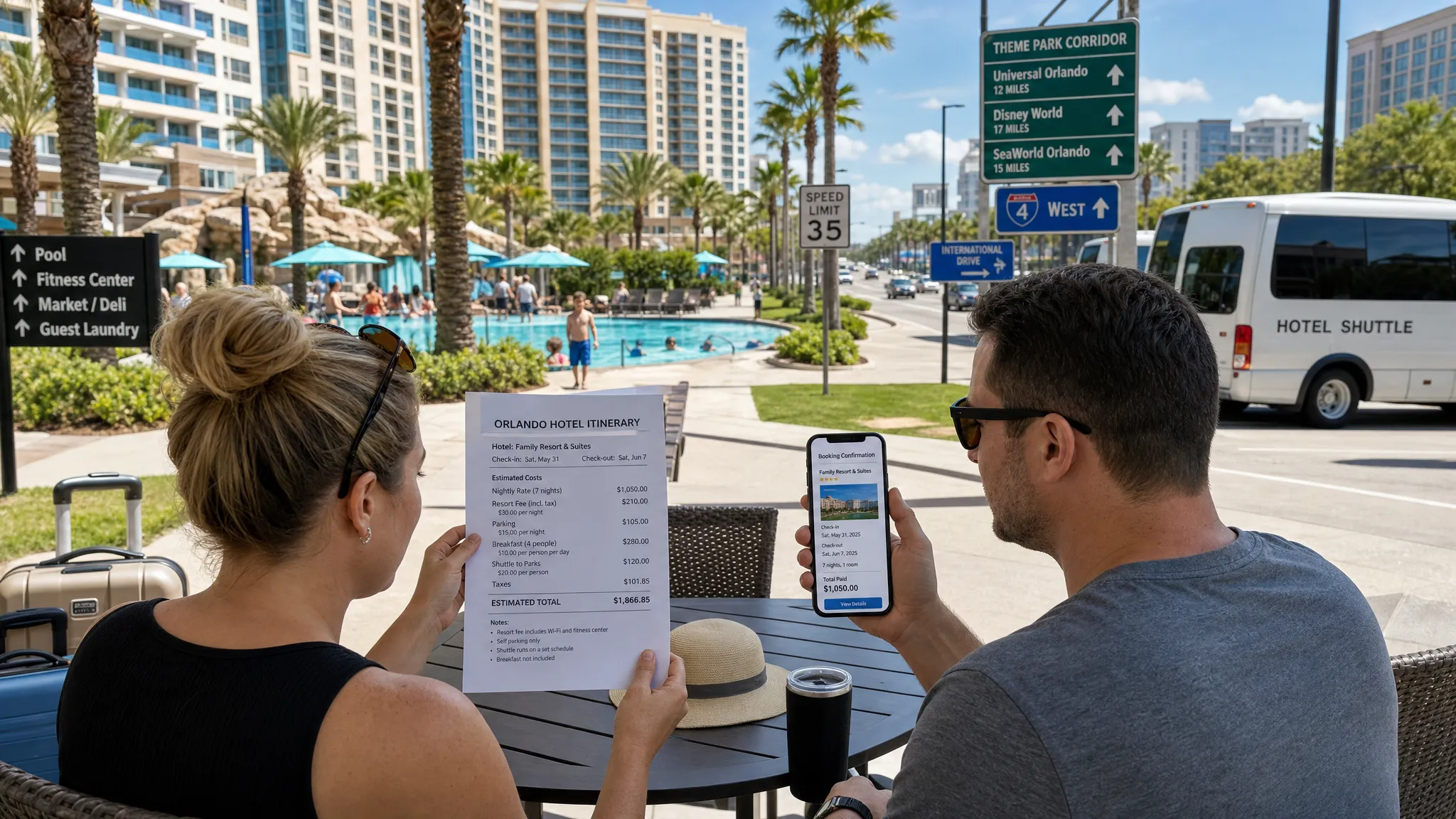
Resort fees are the most obvious example. They may cover amenities you value, such as pools, fitness facilities, local calls, or shuttles, but they may also be unavoidable even if you never use them. Parking is another major variable. A traveler with a rental car should look at hotel parking and destination parking together, not separately. A 25 dollar nightly parking charge becomes more serious when you also pay to park at parks, restaurants, or event venues.
Breakfast is another Orlando trap. A family of four can erase the savings from a cheaper hotel if breakfast is expensive and there are no convenient alternatives nearby. The same applies to coffee, bottled water, late-night snacks, and delivery fees after long park days.
Room upgrades deserve special skepticism. A pool view may be pleasant, but it is not always worth a large premium if you will be out all day. A theme park view can be magical when it is genuinely unobstructed and you plan to be in the room at the right time. It can also be marketing language for a distant angle over rooftops and parking lots.
| Cost to check | Why it matters in Orlando | Smart booking question |
|---|---|---|
| Resort fee | Can change the true nightly rate | Is it mandatory, and will I use what it covers? |
| Hotel parking | Common around resorts and convention areas | Is parking daily, valet-only, or included? |
| Theme park transportation | Shuttles vary widely by schedule and convenience | Does the shuttle match my park hours, or will I still need rideshares? |
| Breakfast | Families can spend heavily before the day starts | Is breakfast included, nearby, or expensive on property? |
| Early check-in or late checkout | Common need after flights and park days | Is it guaranteed, paid, or only requested? |
| View upgrade | Often emotionally tempting | Will I actually be in the room enough to enjoy it? |
| Package handling | Relevant for business travelers and online orders | Does the hotel charge for deliveries or storage? |
| Cancellation terms | Weather and itinerary changes matter | Can I adjust plans without losing the full booking? |
A useful rule: if a hotel looks cheaper by less than the cost of one rideshare round trip, one breakfast, or one parking night, it may not be cheaper at all. For a deeper look at how small hotel decisions add up, InnRox breaks down common hotel booking mistakes that quietly raise total cost.

Orlando forces a choice that many travelers do not name clearly enough: are you buying atmosphere, efficiency, or access?
A luxury resort near the parks can be the right answer for travelers who want the hotel to be part of the vacation. This is where the pool matters, the lobby matters, service matters, and returning to the property feels like a continuation of the day rather than a pause from it. For a family with rest days, a couple celebrating something, or travelers who want resort dining and polished service, the premium can make sense.
A practical hotel near International Drive or the convention center is different. It may not feel as special, but it can win on logistics. If you are moving between meetings, restaurants, theme parks, and attractions, you may not need resort theater. You need predictable access, a clean room, a manageable total price, and fewer surprises.
A boutique or neighborhood-oriented stay in Winter Park, Downtown, or nearby local districts offers a third style. It trades theme park proximity for atmosphere. Instead of souvenir shops and chain-heavy corridors, you get neighborhood restaurants, coffee shops, lakeside walks, and a more lived-in version of Central Florida. This is not the best choice for every family vacation, but it can be excellent for couples, solo travelers, remote workers, and business travelers adding leisure time.
The classic luxury vs modern luxury comparison matters here. Classic Orlando luxury often means resort grounds, pools, valet service, large lobbies, and a self-contained experience. Modern luxury may mean speed, design, strong Wi-Fi, walkable dining, and efficient service near business districts. One is not automatically superior. The better choice is the one that matches how you will spend your hours.
The tourist corridors are convenient because they are built for visitors. International Drive has restaurants, attractions, shops, and hotels at nearly every price point. Lake Buena Vista and Disney Springs areas are designed around families and vacation flow. These areas reduce friction, especially for first-timers.
They also concentrate demand. During school breaks, holidays, and major event periods, the same corridors can become expensive, crowded, and traffic-heavy. A hotel that looks perfectly located on a quiet Tuesday can feel very different on a Saturday night when everyone is returning from parks, dinner, and shows.
Local neighborhoods change the mood. Winter Park brings tree-lined streets, museums, independent dining, and a calmer sense of place. Downtown Orlando can work well for business travelers and nightlife-focused weekends. Lake Nona feels newer and more planned, useful for certain business, medical, and airport-linked trips. These areas often make the trip feel less like a theme park operation and more like a city visit.
The tradeoff is transportation. A local neighborhood stay can save money on room rate or improve atmosphere, but if you are heading to theme parks daily, you may give back the savings in rideshares, parking, tolls, and time. This is where many travelers confuse authenticity with value. A local-feeling stay is valuable when you will actually enjoy the local area, not when you will leave it every morning and return exhausted every night.
Orlando pricing moves with school calendars, holiday demand, weather, and conventions. A hotel that feels overpriced in March may be reasonable during a quieter fall week. A resort that looks like a splurge in winter may be surprisingly competitive during a hot summer stretch when travelers are more selective.
Season also changes atmosphere. Summer can make pool access more important, but heat and afternoon storms can slow down ambitious itineraries. Spring breaks bring energy and long days, but also higher family demand. Fall can offer better value, but flexible cancellation becomes more important when weather disruptions are possible. Late November through New Year can be festive, beautiful, and expensive.
| Travel period | Typical value pattern | Booking tip |
|---|---|---|
| January to February outside holiday weekends | Often better value, but convention dates can spike | Compare weekdays carefully near the convention center |
| March to April | Spring break pressure raises family demand | Book earlier and avoid paying for unused upgrades |
| May to early June | Shoulder-season opportunities | Look for flexible terms before summer crowds build |
| June to August | Hot, busy, pool-focused travel | Choose hotels with amenities you will actually use |
| September to mid-November | Often stronger value outside event periods | Prioritize cancellation flexibility and transport clarity |
| Thanksgiving to New Year | High demand and festive atmosphere | Treat convenience as a premium purchase, not a default |
Weekday and weekend patterns can surprise people. Convention-area hotels may rise sharply midweek when business demand is strong. Theme-park areas may become more expensive around weekends and school breaks. If your dates are flexible, moving a trip by even a day or two can change the total cost.
In walkable cities, the hotel neighborhood is the main decision. In Orlando, transportation is part of the hotel product whether the hotel says so or not.
A rental car gives freedom, especially for families visiting multiple parks, shopping areas, and restaurants. But the total cost should include rental price, tolls, gas, hotel parking, destination parking, and the mental load of driving after long days. A hotel with free or lower-cost parking may beat a slightly nicer hotel with expensive valet-only parking, depending on your itinerary.
Rideshares can work well for couples or short stays, especially if you do not want to manage parking. The risk is surge pricing, long pickup zones, and repeated small costs. One or two rideshares may be easy. Twelve rideshares over a week can change the budget.
Hotel shuttles are valuable only when the schedule fits your plans. A shuttle that leaves too late for your preferred park arrival, returns too early for evening entertainment, or serves multiple hotels with long loops may be less convenient than it sounds. Before choosing a hotel because it offers transportation, check frequency, reservation requirements, destinations served, and return times.
Walkability is also different in Orlando. A hotel may be near restaurants by car but unpleasant on foot because of wide roads, heat, traffic, or long intersections. If you want to walk to dinner, choose a compact area where walking is realistic, not just technically possible.
For families, the smartest hotel is usually the one that reduces friction. That may mean a higher rate near parks, a room with more space, breakfast that simplifies mornings, or a pool that gives kids a break. Families often overpay for views and underpay for convenience. If the choice is between a nicer view and a better location, location usually wins.
For business travelers, the hotel should protect time. Staying near the convention center, Downtown, Lake Nona, or the airport can be smarter than chasing a lower rate in a vacation-heavy zone. Check Wi-Fi expectations, meeting access, parking, breakfast speed, and whether package handling or early check-in matters. A hotel that saves 20 minutes each morning can be worth more than a slightly larger room.
For couples, the best choice depends on whether Orlando is a theme park escape or a relaxed city break. If parks are the point, stay close and reduce transfers. If food, cocktails, museums, and neighborhood atmosphere matter, consider Downtown or Winter Park. A boutique-style stay can feel more romantic than a large resort if you do not plan to use resort amenities.
For luxury travelers, the key question is whether the premium is experiential or cosmetic. Pay more for service, grounds, spa access if you will use it, better dining, room quality, and genuinely easier logistics. Be cautious with upgrades that only change the label of the room. A partial view, a higher floor, or a vague premium category may not improve the trip enough to justify the price.
For deal hunters, the cheapest hotel should pass a total-cost test. Add parking, resort fees, breakfast, expected rideshares, and time lost in traffic. Then compare again. A good cheap hotel is not just low-priced. It is clean, well-located for your plans, transparent on fees, and not so far away that the savings disappear.
For short-notice bookings, prioritize clarity. Last-minute Orlando rates can swing widely, especially around events and holidays. Choose flexible terms where available, confirm the final price before booking, and avoid rooms that look discounted only because the location is inconvenient or the fees are high.
Premium upgrades are worth considering when they solve a real Orlando problem. A larger room can be worth it for families who need sleep and space. A hotel with strong pool areas can be worth it if you have rest days. A better location can be worth it if it removes multiple rideshares or stressful drives. A flexible booking can be worth it if weather, flights, or group plans may change.
They are less convincing when they are purely emotional. A view you will barely see, a club level you will not use, a spa access promise with limited availability, or a fancy room category far from elevators can disappoint. Orlando days can be long. The best upgrades support how you actually travel, not how the hotel photography makes you imagine you will travel.
One useful method is to assign every upgrade a job. Does it save time? Reduce stress? Replace another cost? Improve sleep? Make rest days better? If it does none of these, it may be marketing rather than value.
Before you reserve, build the trip in this order: itinerary, area, transport, hotel category, total price, then cancellation terms. Most travelers do the opposite. They sort by price, fall in love with photos, and only later realize the hotel does not match the trip.
Start by marking your non-negotiables. If you have three Disney days, one Universal day, and one pool day, Lake Buena Vista or a Disney-adjacent resort area may make sense. If you have a convention plus one park day, International Drive or the Convention Center area may be better. If you have one night before a cruise connection, flight, or business meeting, airport convenience may beat vacation atmosphere.
Then compare total price, not display price. A transparent booking flow matters because Orlando has too many small variables for guesswork. InnRox is designed for travelers who want clear terms, upfront final pricing, fast reservations, and fewer unnecessary steps. You can compare Orlando hotel options on InnRox when you are ready to match the neighborhood to your actual plans.
The smartest Orlando hotel is rarely the cheapest and not always the most famous. It is the one that lets your trip move smoothly. It puts you close to what matters, honest about what costs extra, and realistic about how you will spend your time.
What is the best area to stay in Orlando for a first visit? For a first visit focused on theme parks, Lake Buena Vista, Disney Springs, Universal, or International Drive are usually the easiest areas. Choose based on which parks you will visit most, not which hotel looks central on a map.
Is it better to stay near Disney or International Drive? Stay near Disney if most of your trip is Disney-focused and you want easier family logistics. Choose International Drive if you are mixing Universal, conventions, restaurants, attractions, and multiple parts of Orlando.
Are Orlando resort fees common? Many resort-style hotels charge mandatory fees, especially in tourist-heavy areas. Always check whether the fee is included in the final price and whether the covered amenities are useful for your trip.
Should I rent a car in Orlando? A car can be helpful for families, multi-park trips, shopping, and off-site dining. However, compare the full cost against rideshares and shuttles, including hotel parking, tolls, gas, and destination parking.
Are cheaper hotels in Kissimmee worth it? They can be, especially for longer stays or road trips, but only if the commute works for your itinerary. Add transport time, parking, tolls, and fatigue before deciding the lower nightly rate is a true deal.
Orlando rewards travelers who book with a plan. Decide your area first, check the real total cost, and be honest about how much time you want to spend in transit.
With InnRox, you can search hotel stays with clear pricing, transparent terms, instant confirmation, and flexible options where available. Start with the map, compare the total value, and choose the Orlando hotel that fits the trip you actually want to take.
Tags