

InnRox
Travel Experts
March 21, 2026
11 min read
A city break has a particular kind of clock. It starts the moment you step off the train or out of the rideshare, when your weekend is still unspent and every wrong turn feels expensive.
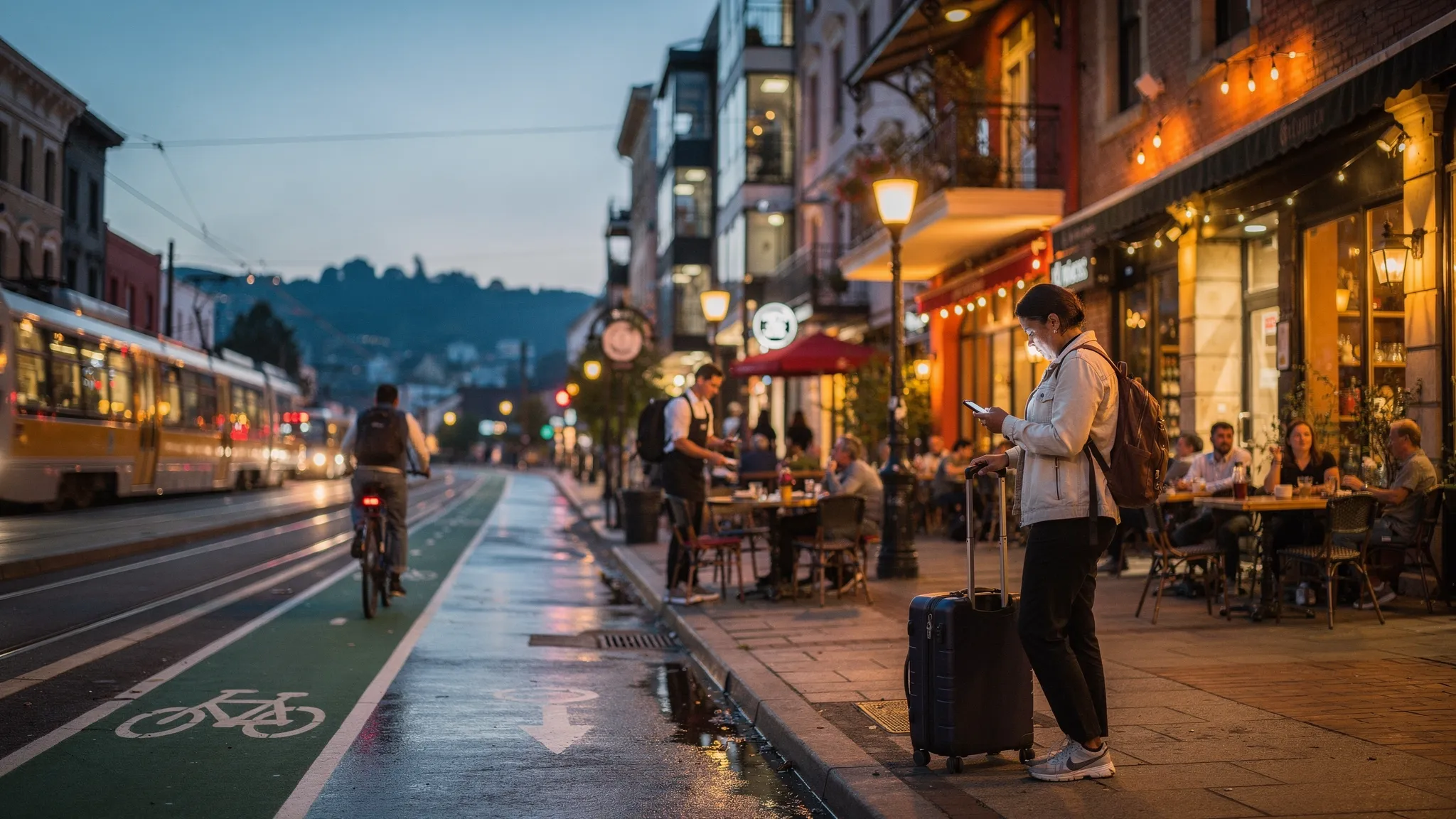
On a Friday night in Lisbon, I watched a couple pause under the glow of a pharmacy cross, phones tilted like compasses. They had a hotel booked “in Lisbon,” but Lisbon is not a single place. It is a stack of neighborhoods, each with its own volume level, hills, dinner hours, and definition of “walkable.” Their map looked close. Their feet would learn the difference.
That’s the core problem with hotels for city breaks: you rarely choose the wrong hotel, you choose the wrong neighborhood. The good news is you can pick the right one fast, without turning your planning into a second job.
When time is short, don’t start with hotel stars or brand names. Start with how you want your days to move. You’re not just booking a room, you’re booking the space between everything you want to do.
Here’s a simple filter you can run in about ten minutes, even while you’re boarding your flight.
Pick one. You can still visit the others.
If you try to get all four, you usually end up with none.
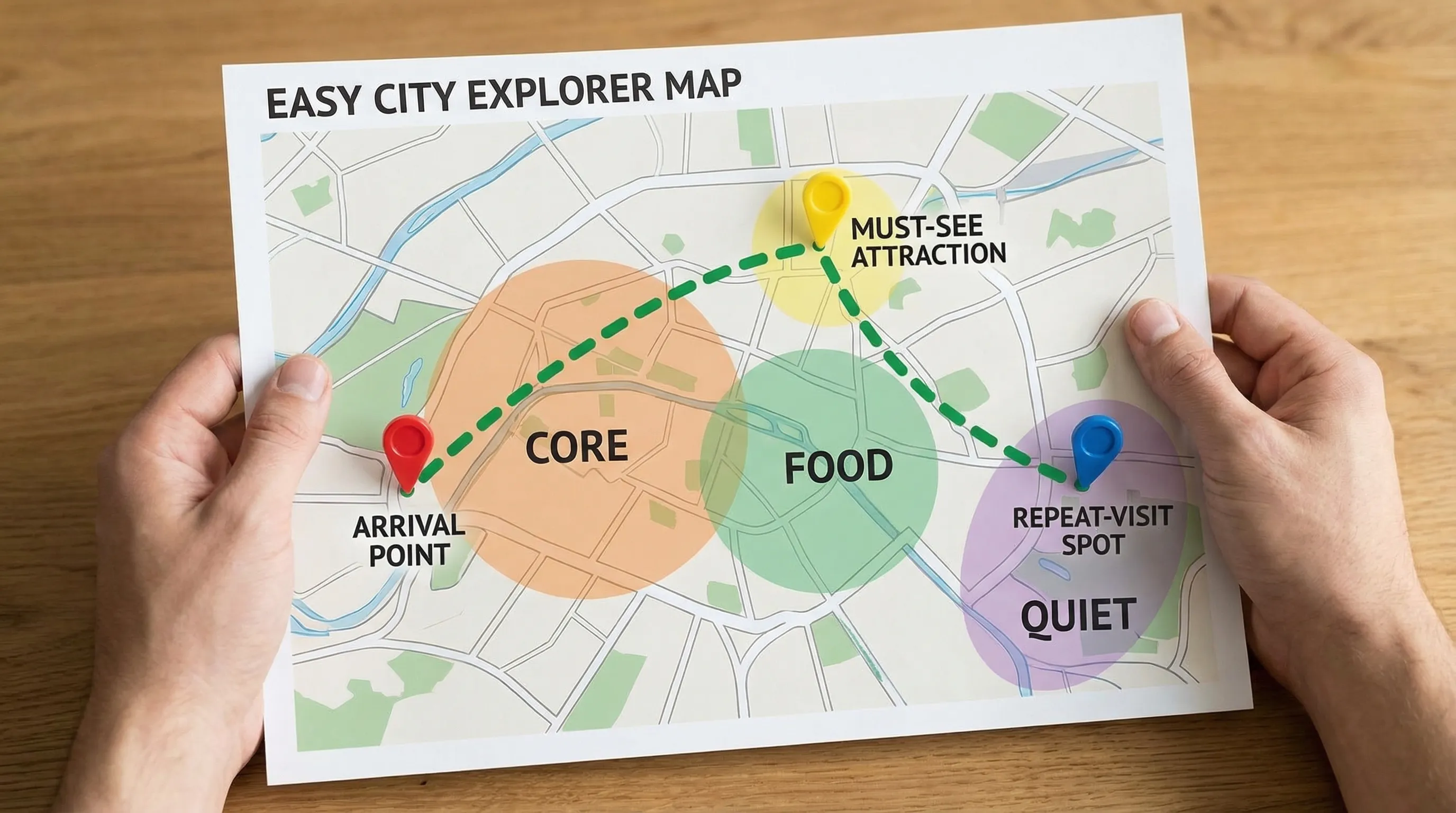
Drop three pins:
Now zoom out until you can see them all. The best neighborhood for a short stay is often the one that turns those three pins into one simple line, not a triangle that forces you to crisscross town.
Once you’ve done this, you’re ready to pick quickly, and with confidence.
Instead of describing neighborhoods like a guidebook, let’s “walk” them. Imagine you arrive, bags in hand, and you’re deciding where you want to come back to at the end of the day.
Lisbon’s light hits stone like it’s been polished for centuries. The city smells faintly of espresso and grilled fish near the squares, then shifts to warm laundry and jacaranda on residential streets. But Lisbon also climbs. Your phone might say twelve minutes. Your calves might say twenty.
If you want the classic, efficient weekend: look toward Baixa and Chiado. Streets feel like an outdoor living room, transit links are practical, and you can pivot quickly between viewpoints, shopping streets, and riverfront walks.
If you want romance and old Lisbon atmosphere: Alfama is a beautiful tangle of lanes and tiled facades, but it’s slow travel by design. It’s the kind of place you choose because you want to hear footsteps on stone at midnight.
If you want dining and nightlife with a modern edge: Príncipe Real and parts of Bairro Alto keep you close to energy, with the tradeoff that you’ll want good windows and a plan for sleep.
A quick local-feel test: pull up a street view (or just look around when you arrive) and ask, “Do I see families walking, or mostly visitors?” Both can be great. The difference tells you how the neighborhood will feel at 8 am.
If you want to stay central so you can move fast between viewpoints, cafés, and the riverfront without overthinking logistics, start with a focused search for a Lisbon base like this:
https://innrox.com/hotel-search?direction=Hotel+Santa+Justa+Lisbon
Once you’ve anchored yourself, Lisbon gets generous. You can ride the tram for the experience, not because you have to.
Copenhagen has a different rhythm. Bikes slide past like quiet punctuation, and even busy streets feel engineered for ease. The air can carry a salty hint from the harbor, and in cooler months you’ll notice the soft glow of candlelit windows everywhere, a casual kind of coziness that isn’t staged.
If you want “walk-out-and-win” convenience: Indre By (the inner city) keeps you close to canals, major sights, and classic Copenhagen strolling.
If you want a creative, food-forward weekend: Vesterbro is where old industrial edges softened into bakeries, wine bars, and design shops. It’s a neighborhood that makes you feel like you’re in on something, even if you’re only there for two nights.
If you want a local, slightly scruffier charm: Nørrebro is lively and diverse, great for eating your way through the city, but it can be a longer hop if your must-sees are clustered in the center.
Fast decision tip for Copenhagen: choose based on your morning. If you want to wake up and immediately be in “postcard Copenhagen,” go central. If you want to wake up and immediately be in “best coffee and pastries,” choose the neighborhood whose breakfast spots make you want to set an alarm.
To keep the weekend efficient while still landing in an area with personality, a Vesterbro-leaning search is a strong starting point:
https://innrox.com/hotel-search?direction=Hotel+SP34+Copenhagen
This is the kind of base that lets you do a museum morning, a harbor walk at golden hour, and a long dinner without spending your best hours in transit.
Mexico City is big in the way oceans are big. You don’t conquer it, you choose a loop and savor it. The city’s sounds are layered: street vendors calling softly, traffic in the distance, a sudden burst of laughter outside a taquería. The smell of masa and grilled corn can appear at any corner, then vanish as you turn onto a greener residential street.
If you want a first-timer sweet spot: Roma and Condesa are leafy, walkable, full of cafés, parks, and galleries. They’re excellent for a short stay because the neighborhood itself is part of the itinerary.
If you want historic grandeur: Centro Histórico gives you the drama of old plazas and major landmarks, especially rewarding early in the morning before the day fully accelerates.
If you want food exploration with a side of calm: neighborhoods bordering Chapultepec can make your trip feel spacious, because the park becomes your reset button.
Fast decision tip for Mexico City: choose based on your evenings. If late dinners, mezcal bars, and casual night walks are your thing, you’ll appreciate staying where the streets still feel inviting after dark.
For a stylish, walkable base that keeps you close to parks, dining, and easy movement across the city, start here:
https://innrox.com/hotel-search?direction=Condesa+Hotels+Mexico+City
Once you choose your loop, Mexico City stops feeling overwhelming and starts feeling endless in the best way.
You can pick a neighborhood fast if you score it the way your weekend will experience it. Here’s a simple scorecard you can use in any city.
| What to check | Why it matters on a city break | Quick way to verify in 60 seconds |
|---|---|---|
| Walkability where you’ll actually walk | “Walkable” is meaningless if it’s only walkable to offices | Look for clusters of restaurants, cafés, and small shops within a few blocks |
| Transit after dinner | The hardest commute is the one you do tired | Check whether the nearest transit runs late, or if rideshares are common |
| Noise profile | Great neighborhoods can be loud neighborhoods | Scan reviews for “street noise,” “bars,” “thin windows,” “early traffic” |
| One daily anchor nearby | A park, waterfront, or market makes days feel longer | Find a green space or market you can reach in 10 minutes on foot |
| Arrival and departure friction | Short stays suffer when airport links are complicated | Look for a direct train/bus line or a straightforward ride |
| Safety and comfort cues | Comfort changes how far you’ll roam | Check whether people mention walking at night comfortably (and trust patterns, not single comments) |
If you only have time for three checks, do walkability, noise, and late transit.
Most bad city breaks have the same postmortem: “The hotel was fine, but…” These are the “buts” to avoid.
The fastest fix is honest self-knowledge: are you here to explore, to rest, to eat, to work, or a mix that needs clear boundaries?
Once you’ve chosen a neighborhood, the rest should be simple: find a hotel that matches your sleep needs, your cancellation preferences, and your budget, then lock it in.
InnRox is built for travelers who want value and clarity. That matters when you’re booking a short city stay, because you’re often making quick decisions and you do not want surprises at checkout. Seeing the final price upfront, getting instant confirmation, and filtering for flexible options (like free cancellation or pay-later where available) can be the difference between a spontaneous weekend and a stressful one.
If you’re doing a classic “core neighborhood” approach and want a quick way to compare options without extra noise, start with a targeted search around a central base and refine from there:
https://innrox.com/hotel-search?direction=Central+City+Hotels
Then zoom in on your scorecard: walkability first, noise second, transit third. Everything else is a bonus.
Sometimes a city break isn’t purely leisure. You might be pairing a concert with client meetings, adding two vacation nights onto a conference, or flying in for a quick signing and staying for the weekend. In those cases, the “right neighborhood” is the one that reduces uncertainty: near your meeting point, near reliable transit, and near services you can actually use.
If your travels take you to Jamaica for business, it can help to know where to find established local professional support. For example, here’s the site for Henlin Gibson Henlin, a leading international law firm in Jamaica, which can be a practical reference point if legal logistics are part of your trip.
The neighborhood lesson is simple: if you have a fixed appointment, build your hotel choice around it first, then choose the most enjoyable area that still keeps your commute predictable.
And even on work-heavy trips, give yourself one “easy win” nearby: a park loop, a great breakfast spot, or a waterfront walk. It’s the small, repeatable ritual that makes the city feel like yours, even briefly.
A great city break is a chain of small moments that happen easily: a coffee you stumble into, a museum you didn’t rush, a dinner that runs late without consequences. Neighborhood is what makes those moments possible.
Choose your home base type, run the three pins test, check the two friction points, then book the hotel that protects your sleep and your schedule. Do that, and the city stops being a map. It becomes a weekend you can actually feel, step by step, street by street.