
InnRox
Travel Experts
April 1, 2026
9 min read
Niagara Falls has a way of shrinking your plans.
You arrive thinking in checklists (viewpoint, boat ride, souvenirs), and then the first breath of gorge air snaps everything into something older and simpler: water, stone, mist. The sound does not come from a single direction. It’s everywhere, a steady thunder that makes your footsteps feel like part of the landscape.
This is a place that rewards travelers who move slowly and on foot, especially on the U.S. side where Niagara Falls State Park and the gorge paths stitch together the best scenes without needing a car between each stop. If you’re searching for cheap hotels in Niagara Falls USA, the secret is to stay close enough to walk, because every ride share you skip becomes another meal, another ticket, or another night you can afford.
Niagara’s U.S. side is compact, but it feels huge because the gorge cuts deep and the water pulls your gaze. The classic views cluster around:
When you anchor your trip here, your “transportation plan” becomes a pair of comfortable shoes. That matters when you’re aiming for cheaper lodging, because the best-value properties are often just outside the priciest blocks but still walkable.
What follows is the route I use when I want the Falls to feel like a landscape (not an attraction), and when I want my spending to go toward experiences rather than logistics.
Start before the crowds, while the park still smells like wet leaves and cold river air. At sunrise, the American Falls look flatter and wider, and the mist rises in gentle sheets rather than explosive gusts.
You’ll hear birds cutting through the roar, and the first tour buses are still only a rumor. If you’re traveling in shoulder season (early spring or late fall), the quiet can feel almost unreal, like the whole state park has been unlocked just for you.
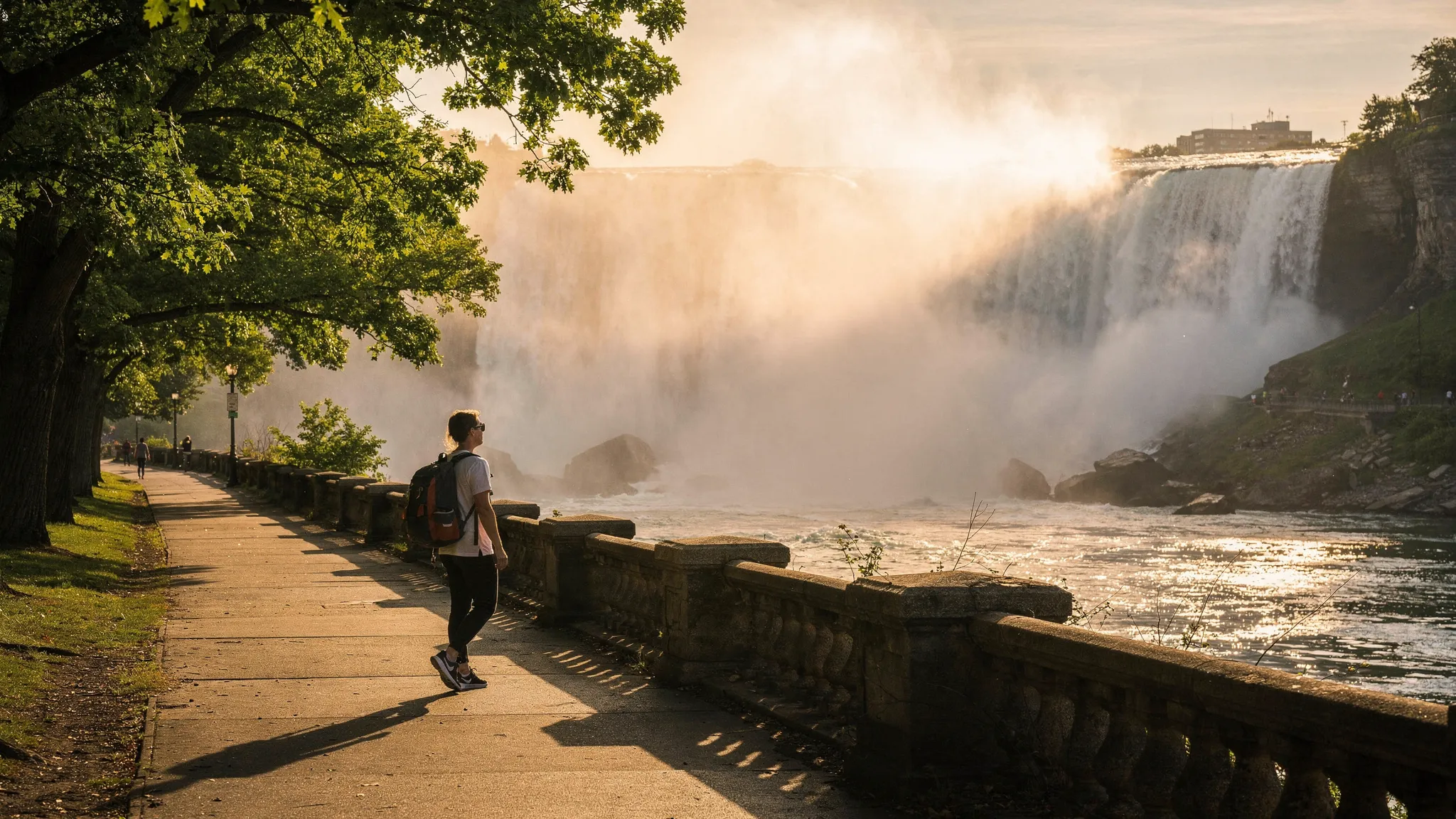
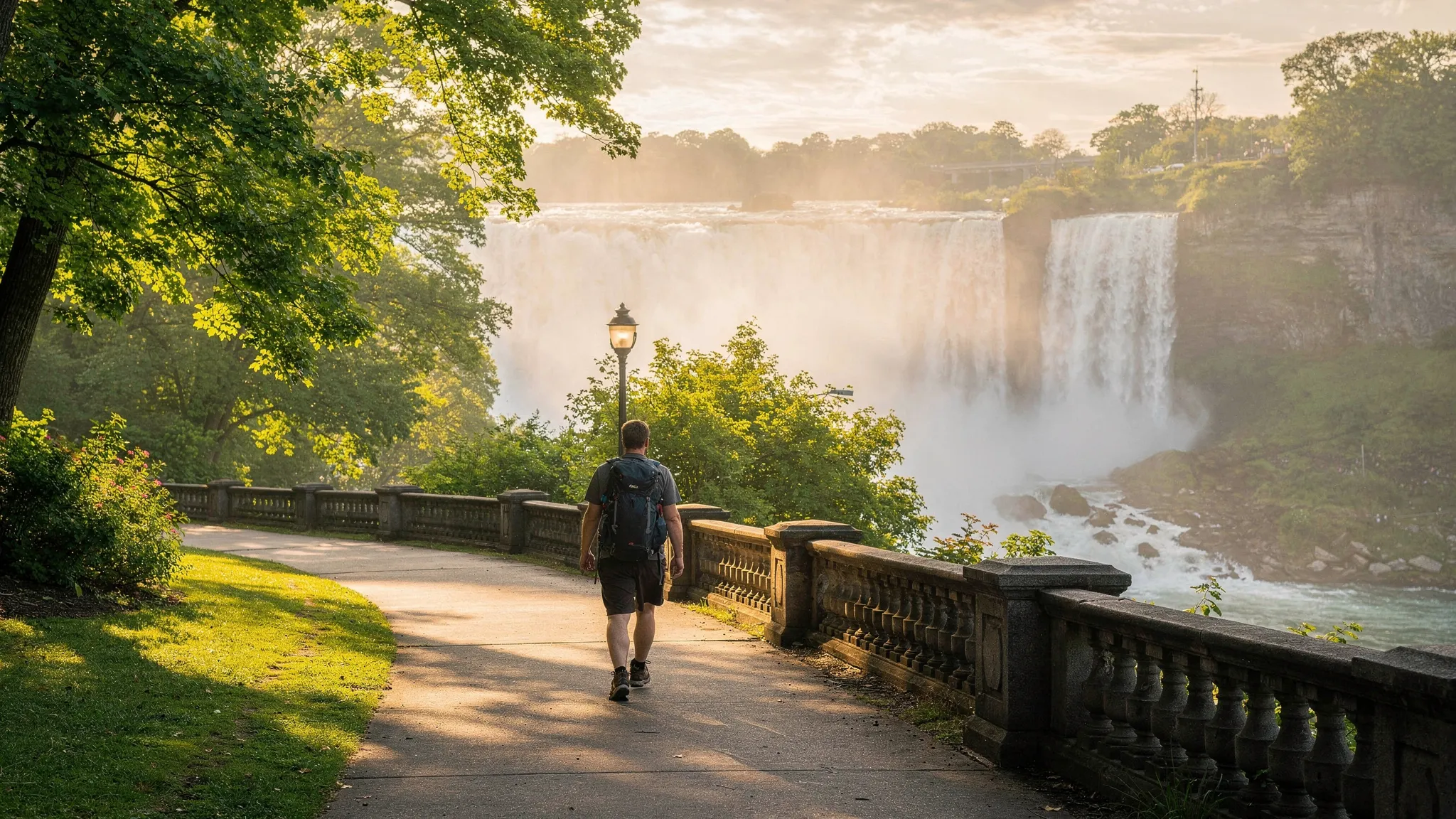
Cross onto Goat Island and let the island do what it does best: pull you away from the street grid and into a pocket of green. The sidewalks here are forgiving, and the scenery changes quickly, one bend offering framed waterfall views, another opening into river channels and rapids.
This is where you start to feel Niagara’s design, not architectural design, but geological design. The land is shaped around force. The paths exist because the rock allows them, not because someone wanted a straight line.
At some point you’ll get close enough that the mist finds you, no matter how you angle your body or zip your jacket. Embrace it.
Bring a light layer that dries quickly and consider packing a spare pair of socks if you’re walking all day. The damp is part of the experience, and it’s also the most common reason people cut their walk short and retreat to a car.
By midday, the sidewalks around the park can feel louder, not just with voices but with the clatter of crosswalks, snack wrappers, and the constant pulse of people moving toward viewpoints.
This is when a short walk into downtown helps. Even a modest lunch feels like a reset when you step away from the mist and into warmer air, where you can sit down, charge your phone, and look at the map without being jostled.
If you’re keeping things cheap, midday is also the moment to decide what you truly want to pay for. Niagara can be a full day of free views and gorge walks, or it can become a parade of add-ons. Walking gives you time to choose.
In the afternoon, head toward the gorge trails. Here the Falls are no longer a postcard backdrop, they’re upstream power. The river narrows, accelerates, and the sound changes pitch.
Look down and you’ll see currents twisting like braided rope. Look up and you’ll notice the cliffs holding the city at the edge. It’s a reminder that Niagara isn’t only “the waterfall”, it’s a whole river system grinding away at stone.
If you’re traveling with kids or anyone who prefers an easier pace, treat the gorge like a choose-your-own adventure: walk until the scenery feels complete, then turn back. The win is not distance, it’s immersion.
As the light turns honey-colored, the water takes on a smoother texture in photographs and in your memory. The crowds thin as day-trippers leave, and the park starts to exhale.
This is the best time to do a slower loop back, noticing details you missed in the morning: the slick sheen on the railings from constant mist, the sound of the river changing with the wind, the way the light catches in spray and turns it briefly into fog-glow.
Niagara after dark feels like a second destination. The air cools fast near the gorge, and the night energy shifts toward lights, late dinners, and last looks.
Even if you’re a budget traveler, this is worth staying out for. It costs nothing to walk back to the overlook and watch the scene transform.
Distances vary by the exact route you take inside the park, but this gives you a realistic walking framework.
| Segment | What it feels like | Typical walking time (one way) |
|---|---|---|
| Prospect Point to Goat Island entry | Easy sidewalks, high payoff fast | 10 to 20 minutes |
| Goat Island loop (partial) | Shaded paths, frequent viewpoints | 30 to 75 minutes |
| Park area to downtown core | Street grid, quick lunch break | 10 to 25 minutes |
| Park area to gorge trail access (varies) | More open views, breezier | 20 to 45 minutes |
The best budget strategy is to stay in one of these “walking-strong” zones:
Staying near the park usually costs more than the far edges of town, but it can be the better deal overall if it lets you:
https://innrox.com/hotel-search?direction=Niagara+Falls+State+Park
That search is a good starting point when you’re comparing rates close to the main sights. Focus on total price and cancellation terms, not just the nightly rate.
If flexibility matters, prioritize properties that offer free cancellation or pay-later options where available. It’s the easiest way to keep your trip affordable when plans shift.
Downtown can be a sweet spot for deal hunters: you’re close enough to stay mobile on foot, but often far enough from the most expensive “front row” blocks.
https://innrox.com/hotel-search?direction=Downtown+Niagara+Falls+NY
When you browse, check how long it takes to walk to the park entrance. A hotel that’s an extra 12 minutes away can be significantly cheaper, and on a walking-first itinerary, that distance is part of the experience.
If your priority is price comparison across many properties, start broad, then narrow.
https://innrox.com/hotel-search?direction=Niagara+Falls+NY
As you filter, look for clean, straightforward value: transparent final pricing, clear policies, and a booking flow that doesn’t bury the real cost.
Niagara is famous, but it isn’t only expensive. The core experience is elemental and public: viewpoints, trails, air that tastes faintly mineral near the spray.
A walking-first approach helps you keep the trip grounded:
A few details change the whole day.
Bring a small day bag with:
Also, plan your “warm-up break.” Even in summer, the gorge can feel cooler than the streets. A midday indoor pause makes the afternoon walk feel like a second act, not a grind.
Niagara is often sold as a single dramatic moment, a gasp at the railing, a photo, then onward.
But if you give it a full day on foot, it becomes something richer: a living landscape that changes hour by hour. Morning mist that softens everything. Midday light that sharpens every edge of rock and water. Evening color that turns the gorge theatrical.
And when you find the right base (close enough to walk, affordable enough to breathe), the Falls stop being a splurge and start being what they’ve always been: one of the most powerful free shows on earth.