


InnRox
Travel Experts
March 1, 2026
11 min read
You step out of the subway, blink against the LED glare, and feel that familiar travel math start running in your head. It is late, your phone battery is low, and your brain reaches for the fastest shortcut it knows: type “best hotels near me” and pick the highest star rating.
In New York City, that shortcut can be expensive in ways that do not show up on a review score.
Because in a city stitched together by neighborhoods, not boulevards, the area you choose becomes part of your room. It decides whether you fall asleep to delivery trucks or brownstone quiet, whether you walk to dinner through galleries or past loading docks, whether your “quick coffee” is a serene ritual or a shoulder-to-shoulder sprint.
This is a story about choosing the right area, not just a star.
The first time I made the classic mistake, I booked a highly rated hotel because it looked like a deal. On the map, it was “central.” In real life, it was central to congestion, honking, and the kind of fluorescent brightness that makes midnight feel like noon.
The lobby was lovely. The room was fine. But every time I stepped outside, I felt like I had to brace myself. I skipped morning walks. I avoided late dinners. I took more taxis than I wanted, just to dodge the sensory overload.
That is when it clicked: in NYC, the wrong area can drain you faster than a small room ever will.
So the next trip, instead of starting with hotel stars, I started with a walk.
Imagine you have one afternoon before check-in. Drop your bag, grab a coffee, and do what New Yorkers do without thinking: move neighborhood to neighborhood until the city’s texture changes under your feet.
The point is not to see everything. The point is to notice where your shoulders unclench.
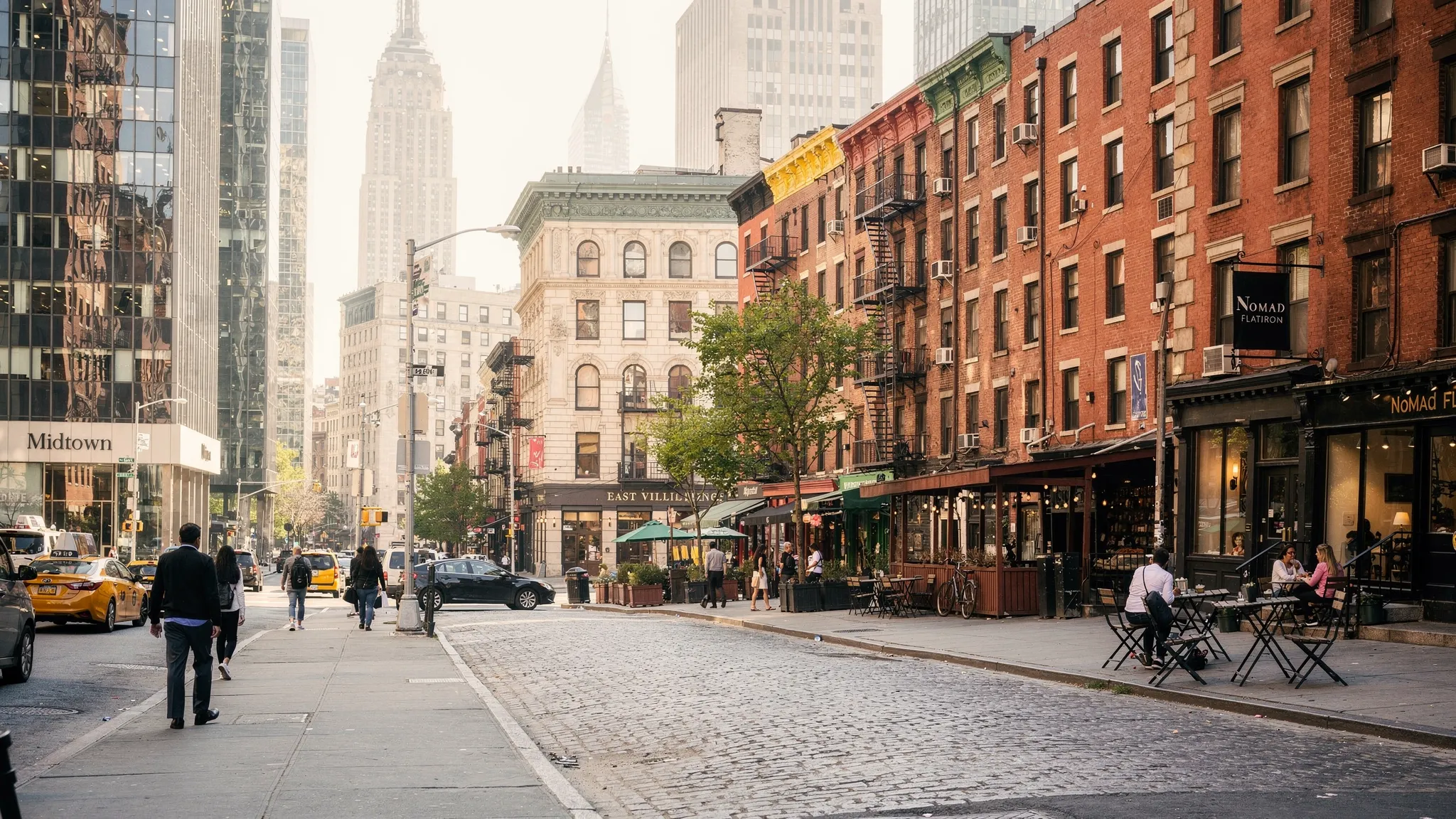
Start in Midtown if you are in town for business, a conference, or a short-notice trip where minutes matter. The air here is all motion: rolling suitcases, revolving doors, espresso lines, the steady percussion of crosswalk signals.
Midtown can be extremely convenient, especially near transit hubs. It can also be intense. If you are even slightly sensitive to noise, crowds, or that end-of-day “my brain is buzzing” feeling, Midtown rewards you for choosing carefully: look for a property on a calmer side street, near a park, or with strong soundproofing.
Travel can also amplify stress in less obvious ways, especially if you are juggling work pressure, sleep disruption, or anxiety. If you are in Manhattan and want a professional, evidence-based option close to the core of the city, you can explore comprehensive psychiatric services in NYC (including telehealth options) as part of taking care of your mind the same way you take care of your itinerary.
Now, back to the practical neighborhood cues. The Midtown version of “near me” should mean near the things you will actually use: your meeting address, your train, a dinner corridor you can walk to, and a pocket of green where the city briefly softens.
If you love the idea of Midtown convenience but want your evenings to feel human, consider aiming for the Bryant Park area. It is still central, but the energy changes when you can step toward trees, lawns, and that library-adjacent hush.
For a Midtown base with a strong location for walking and transit connections, you can start your search here:
https://innrox.com/hotel-search?direction=The+Bryant+Park+Hotel
Walk south and you will feel the shift around NoMad and Flatiron. The streets open up, the buildings start showing older stone and cast detail, and the pace becomes less about rushing and more about flowing.
This is where “best hotels near me” often means: I want to be close to Manhattan’s core, but not swallowed by it. You get strong subway access without the constant brightness of Times Square-adjacent blocks. You also get a surprisingly good rhythm for travelers who work by day and explore by night.
NoMad is a smart pick if you care about:
If that sounds like your version of “near,” this is a useful starting point:
https://innrox.com/hotel-search?direction=Arlo+NoMad
Keep walking downtown and you reach Union Square, then the East Village. Here, the city smells different. Less cologne and commuter coffee, more bakeries, sizzling onions, and that faint electric note of music spilling from a doorway you cannot quite place.
This area is not for everyone, and that is the point. If your goal is early nights and silent mornings, you may feel like the neighborhood never fully sleeps. But if you want to be in the middle of NYC’s everyday life, where dinner can turn into dessert and dessert can turn into “one more stop,” the East Village delivers.
The practical trick is to choose your micro-area. One avenue can mean quiet residential blocks. The next avenue can mean late-night foot traffic until 2 a.m. When you search, zoom in and look for nearby bars, venues, and all-night diners. Those can be a dream, or a problem.
To explore hotel options that put you close to the neighborhood’s restaurants and transit without overcomplicating the booking, start here:
https://innrox.com/hotel-search?direction=Moxy+NYC+East+Village
Drift a little farther down and the Lower East Side tightens around you, in the best way. The streets are narrower, the storefronts feel more personal, and the neighborhood has a lived-in creative pulse that makes even a short stay feel like a story.
This is a strong area for travelers who want to spend less time commuting and more time tasting. You can build an evening entirely on foot: noodles, a bakery, a small gallery, a last drink, and then an unhurried walk back to your hotel.
But again, the block matters. Some corners feel residential and calm. Others are pure nightlife. If you are traveling for work and you have an 8 a.m. start, do not assume a highly rated property guarantees quiet. In this part of Manhattan, quiet is a location feature.
SoHo and Tribeca can feel like a different city altogether. There is a visual softness here: historic façades, cobblestone textures, and a sense of curated calm that appears between the crowds.
If your travel fantasy includes morning light on old architecture, shopping breaks between meetings, and dinners where you can actually hear the person across the table, this is a compelling base.
Tribeca, in particular, tends to read quieter at night than some nearby areas, while still giving you quick access to downtown and beyond.
If you want to anchor your stay in this part of Lower Manhattan, here is a search to start with:
https://innrox.com/hotel-search?direction=The+Roxy+Hotel+Tribeca
If Manhattan is feeling too loud, take the subway across the river and try Brooklyn Heights or DUMBO. The first thing you notice is the soundscape. Fewer horns, more footsteps. The second thing is the light. The skyline becomes something you look at, not something that towers over you.
Brooklyn Heights gives you brownstones and quiet streets that feel almost cinematic in their stillness. DUMBO gives you warehouse bones, big views, and the sense that you are close to the city but not inside its pressure.
This area is a strong choice for couples, walkers, and anyone who wants to wake up early and start the day with a waterfront stroll.
To look for a waterfront-leaning stay with that “exhale” feeling, start here:
https://innrox.com/hotel-search?direction=1+Hotel+Brooklyn+Bridge
When you search “best hotels near me,” your phone is usually solving for distance. You need it to solve for fit. Here is a quick framework that works especially well in NYC, but also translates to most big cities.
First, decide what you want your nights to feel like. Not what your itinerary says, but what your body wants after a long day.
Then, pressure-test the neighborhood with three questions:
To make it easier, here is a neighborhood snapshot you can use as a starting map.
| Area | Best for | What it feels like | Watch-outs |
|---|---|---|---|
| Midtown (Bryant Park area) | Business trips, first timers, short-notice stays | Fast, central, bright, very connected | Noise varies block to block, crowds, sensory overload |
| NoMad / Flatiron | Work plus exploring, design-forward stays | Calmer “center,” good late-night wandering | Prices can spike, some blocks are nightlife-adjacent |
| East Village | Food, music, a lived-in NYC vibe | Energetic, compact, character-rich | Late-night sound, small rooms are common |
| Lower East Side | Creative energy, walking-based evenings | Grit-meets-style, excellent dining gravity | Nightlife pockets, uneven quiet |
| SoHo / Tribeca | Shopping, galleries, quieter luxury | Architectural charm, more spacious feel | Can be busy by day, boutique pricing |
| Brooklyn Heights / DUMBO | Slower mornings, skyline views | Airier, scenic, restorative | More subway dependence for Midtown access |
Once you have chosen the area, the hotel decision gets easier, and the booking details get more important.
In NYC, a few practical filters can save your trip:
InnRox Travel is built around that kind of clarity, with transparent terms, fast reservations, and straightforward hotel booking without unnecessary clutter.
Are the “best hotels near me” always the ones with the highest star rating? Not necessarily. Star ratings and reviews capture property quality, but your experience is often shaped more by the surrounding area, noise, walkability, and transit access.
How do I choose the right neighborhood if I have never been to NYC? Start with what you want your evenings to feel like. Midtown is convenient, NoMad is a calmer center, the East Village is lively, and Brooklyn Heights is slower and scenic.
What is the fastest way to avoid a noisy stay? Pick a neighborhood that matches your pace, then choose a hotel on a calmer side street, away from nightlife clusters and major traffic corridors. Reviews that mention “quiet” are often more valuable than generic praise.
Is it better to stay in Manhattan or Brooklyn? Manhattan can reduce commute time for many first-time itineraries, while Brooklyn can offer quieter nights and a more local rhythm. The best choice depends on where you will spend your mornings and how you want your nights to feel.
If you are ready to stop chasing stars and start choosing the area that fits your trip, you can search by hotel name or neighborhood and compare options with clear terms on InnRox.
Browse deals and book your next stay at InnRox Travel.